
By: Bonny Lin, Brian Hart, Leon Li, Suyash Desai, Truly Tinsley, Linda Yang, Feifei Hung
February 24, 2026
Over the last few years, Chinese leader Xi Jinping has waged an internal political war within his own military, conducting unprecedented purges of the People’s Liberation Army (PLA). Due to the opaque nature of China’s political system, there has not previously been a systematic assessment of these purges. To shed light on the scope and impact of the PLA purges, the CSIS China Power Project constructed the CSIS Database of Chinese Military Purges, which contains detailed information on over 100 PLA senior officers who have been purged or potentially purged since 2022. This report summarizes key insights from that dataset and reveals that the PLA purges are far more extensive than previously understood.
The Extent of the Purges
Note: The database that drives this analysis only includes generals and lieutenant generals due to limitations in open-source information below those ranks. Explore the data and methodology.
Since coming to power in 2012, Xi Jinping has repeatedly purged senior military leaders to root out corruption—which Xi sees as an impediment to his ambitious military modernization agenda—and to remove political obstacles. In his first five years, Xi purged two former vice chairmen of the powerful Central Military Commission (CMC), Guo Boxiong (郭伯雄) and Xu Caihou (徐才厚), as well as two sitting CMC members, Fang Fenghui (房峰辉) and Zhang Yang (张阳).
Around 2023, Xi initiated a second major round of purges—this time far bolder and more extensive than before. Over the past few years, Xi purged six members of the CMC including: former ministers of defense Wei Fenghe (魏凤和) and Li Shangfu (李尚福), CMC vice chairman He Weidong (何卫东), Director of the CMC Political Work Department Miao Hua (苗华), Chief of the Joint Staff Department Liu Zhenli (刘振立), and finally senior vice chairman of the CMC Zhang Youxia (张又侠). Their removal has decimated the PLA’s high command, leaving only one sitting general on the CMC, Zhang Shengmin, who was promoted to vice chairman in late 2025.
While purges of the CMC have garnered the most attention, this only scratches the surface. According to CSIS data and analysis, 36 generals and lieutenant generals have been officially purged since 2022. The data also shows 65 additional officers are missing or potentially purged (an assessment that is made based on their absence at important meetings which they were expected to attend). This brings the total of confirmed and potential purges to a staggering 101 people.
Clear public evidence that a purge campaign was underway emerged in 2023 when defense minister Li Shangfu was removed and rumors surfaced that his predecessor Wei Fenghe was also under investigation. Throughout 2023 and 2024, 19 senior officers were officially purged. Corruption was typically cited as the reason, but observers suspect that additional factors played a role, including loyalty and performance issues, PLA leaders developing their own patronage networks and power bases, and factional struggles within the PLA.
The purges escalated significantly in 2025 when 15 general officers were officially purged (9 expelled from the Chinese Communist Party (CCP) and six dismissed from their positions). Even more striking in 2025 was the massive spike in the number of general officers who are potentially purged or under investigation. At least 46 general officers went missing in 2025 based on their absence at key events. For instance, at the CCP’s fourth plenum in October 2025, 14 generals and 5 lieutenant generals were conspicuously absent, in addition to members who had already been officially expelled.
The 101 potential and confirmed purges since 2022 cover not only those who are still active duty, but also those who were purged after they retired. Eleven PLA leaders were purged after retirement, with seven of the eleven retiring before 2022 but purged after 2022.
The majority of the purges targeted those still serving. Three statistics highlight the decimation of China’s senior military leadership. First, of the 47 PLA leaders who were generals in 2022 or promoted to three-star positions after 2022, 41 of them (or 87 percent) were purged or potentially purged (either while in office or after retiring).1
Second, of the 35 three-star generals and admirals that Xi promoted from 2020 onwards, 32 appear to have been investigated and 29 were subsequently confirmed or potentially purged. This is an incredibly high rate of investigations for generals that Xi approved of himself. Most of those who were investigated also ended up purged. Only 3 generals were not investigated: one died due to health issues and the other two are generals whom Xi promoted in December 2025.
It is important to note here that investigations of senior PLA officials often take months and sometimes up to a year to complete, and it is possible more current active officials will be officially expelled from the CCP in the coming months. This is particularly the case for PLA officials who are Central Committee members or alternative members because punishing them requires their cases to be reviewed at a Central Committee plenum.
Third, expanding beyond just three-star generals, Taylor Fravel notes that there are a total of 176 billets or positions designated for senior PLA leaders. Excluding individuals who occupied the exact same positions, the purged and potentially purged individuals in the CSIS dataset represent “approximately 52 percent of positions in the PLA leadership.”
This extraordinary scale of purges makes it clear that no one in the PLA is immune or shielded. Xi not only purged leaders that he handpicked and rapidly promoted—such as CMC vice chairman He Weidong—but also PLA “princelings” and those who have had long and close family ties with him and his father, such as CMC vice chairman Zhang Youxia. Even retirement does not shield leaders from purges.
How the Purges Hit Different Parts of the PLA
These purges have touched virtually every part of the PLA, spanning the CMC, key functional departments under the CMC, the PLA’s four services and four support forces, the five theater commands, military academies, and the People’s Armed Police (PAP).
Looking across the PLA, the greatest number of purged personnel came from the service branches, followed by the theater commands and CMC functional departments. This is not surprising given the larger number of billets for senior officials within these organizations. Each of the four services (Air Force, Army, Navy, and Rocket Force)—as well as the four support forces—is led by a commander and political commissar, and each service has deputy commanders and deputy political commissars, adding to their total billet size. Likewise, each of the five theater commands (Central, Northern, Eastern, Southern, and Western) have a commander and commissar plus several deputy commanders and deputy commissars. Among the CMC’s subsidiary organizations, there are 15 departments, offices, and commissions plus the Joint Operations Command Center—all of which have a commander, political commissar, and often several deputies.
Key developments across these areas are analyzed below.
Services and Support Forces
The purges have impacted all of China’s four services and some of the support forces as well.2 In all, 11 active duty leaders from the services have already been officially purged, and another 16 appear to be potentially purged or under investigation. The purges have reached the highest levels within the services: at least one commander and one political commissar have been purged (or are under investigation) in every service branch.
The Rocket Force has been targeted the hardest, by a wide margin. All four of its past commanders have been officially purged. Deputy commanders, political commissars, and other officials have likewise been purged or are potentially in the process of being purged.
A major factor driving these purges is the investigation into the Rocket Force’s corrupt procurement process that dates as far back as the formation of the branch in 2015. The branch’s control of the PLA’s most important military assets, China’s strategic nuclear missiles, also contributes to its additional scrutiny.
Beyond the PLA Rocket Force, the second hardest hit service was the Army, which has traditionally been the most powerful service in terms of size and number of personnel. It is also historically the service from which most of China’s top military commanders originate. China’s purge of the Army was concentrated in 2024 and 2025, where two commanders, two political commissars, four deputy commanders, and one chief of staff were purged in quick succession.
Purges within the Navy closely follow that of the Army. Similar to the Rocket Force, the Navy’s procurement process has suffered from corruption and capability shortfalls—a fact that is unsurprising given the rapid buildup of China’s fleet. The most visible case of this was the sinking of the first Zhou-class nuclear submarine as it prepared for sea trials in a shipyard in Wuhan in mid-2024. Chinese analysts have also criticized design flaws of China’s newest and first domestically designed aircraft carrier, the Fujian.
To date, only one Air Force leader, former commander Ding Laihang (丁来杭) has been officially purged in recent years, and he was retired at the time. Three other active duty Air Force officials, including a more recent commander, a political commissar, and a deputy commander may be under investigation. The relatively lower rates of purges could indicate that Xi has higher confidence in (or less concerns with) the Air Force. This could be one factor among many that explains why there was such a stark departure from tradition in 2025 when the only two leaders promoted to three-star generals were from the Air Force.
China’s four support forces—which cover aerospace, cyberspace, information, and logistics, have been targeted to a lesser degree in comparison. The leadership within the 2024-established Cyberspace Force has been spared so far. The other newly established support forces, the Aerospace Force and Information Support Force, have also retained their commanders, but the political commissar of the Information Support Force was likely purged, and it is unclear if the Aerospace Force currently has a political commissar. In contrast, the top operational and political leaders of the Joint Logistics Support Force have been purged or potentially purged.
Theater Commands
Since 2022, China has purged or potentially purged the top two leaders—the commander and political commissar—of almost all five theater commands. The only exception was the former Central Theater Commander Wang Qiang (王强), who was missing and likely investigated, then reappeared, and subsequently replaced.
Among the five theater commands, the Southern Theater Command was hit hardest with the purge of a commander, a political commissar, and five deputy commanders (four of whom also had dual roles leading the region’s army, navy, and air force). This meant that the STC leadership was gutted across the board, and, to date, the top two operational and political positions remain vacant. It is likely that a range of factors—including corruption, operational and capability shortfalls, and factionalism—drive the purges instead of a unique factor linked to the STC itself.
Aside from the STC, most other theater commands have either four or three senior leaders purged. Thus far, former Eastern Theater Commander (ETC) Lin Xiangyang (林向阳) remains the only theater commander to be formally expelled from the CCP. All the other purges or potential purges involved leaders who were dismissed or suspended from their positions or are missing and not seen in public.
CMC Subsidiary Organizations
Below the Central Military Commission are fifteen functional subsidiaries and the Joint Operations Command Center that help the PLA plan and integrate across theater commands and services. Since 2022, China has purged or potentially purged seventeen senior leaders from these organizations. Two leaders, Miao Hua (苗华) and He Hongjun (何宏军) from the Political Work Department, were expelled from the CCP, six were dismissed, and nine are missing.
Responsible for combat planning, joint operations, and training, the CMC Joint Staff Department was hit the hardest, with the purges reaching the head of the department Liu Zhenli (刘振立) and four deputies. The CMC Political Work Department, Joint Operations Command Center, and Discipline Inspection Commission each had two leaders purged.
Assessing the Near-Term Impacts on PLA Readiness
The purges have resulted in the removal of PLA leadership responsible for planning and overseeing training and other military operations. This includes purges within the CMC departments that are in charge of joint operations and training across service branches and theater commands—such as the CMC Joint Staff Department and Joint Operations Command Center—as well as purges of theater commanders and service commanders that lead theater-wide exercises and major military training and exercises with foreign militaries.
One way to examine the near-term potential impact on PLA operations is by looking at the breakdown of the purges by career track. The PLA has a dual-track system that includes a political track and an operational track. The political track consists of CCP political commissars and officials that operate side-by-side (and typically at the same grade and rank) with operational commanders to ensure adherence and loyalty to party ideology and directives. The operational track involves military officers who focus on warfighting and training.
Most (61 percent) of active duty senior PLA leaders in the database came from the operational track. In the CMC for example, 80 percent of the officials purged were in key operational roles. This marks the highest percentage of purges of operational commanders and is incredibly impactful because it leaves the current CMC without a military leader from the operational track.
The impact on operational officials is also high within the CMC functional departments, theater commands, and services. Across the theater commands, operational track officers as a percentage of purged leaders varied from a high of over 85 percent of the leaders purged in the Southern Theater Command to a low of 25 percent of the leaders purged from the Central Theater Command.
Another way to examine the impact of the purges on operational readiness is to assess vacancy within the PLA leadership. Of the 52 key PLA leadership positions displayed, only 11 positions (or about 21 percent) are currently filled. But many of the purged positions have also been backfilled with interim or acting commanders and commissars. Interim or acting leaders have temporarily stepped up into 23 other key positions, or about 44 percent of all key positions. Another 12 positions appear to be vacant and there is no information for about 6 of the positions.
To date, it appears that the leadership purges have not significantly disrupted normal PLA functions or operations. The PLA’s centralized system and bureaucracy remain in place, allowing political orders and military instructions to be issued, passed down, and executed.
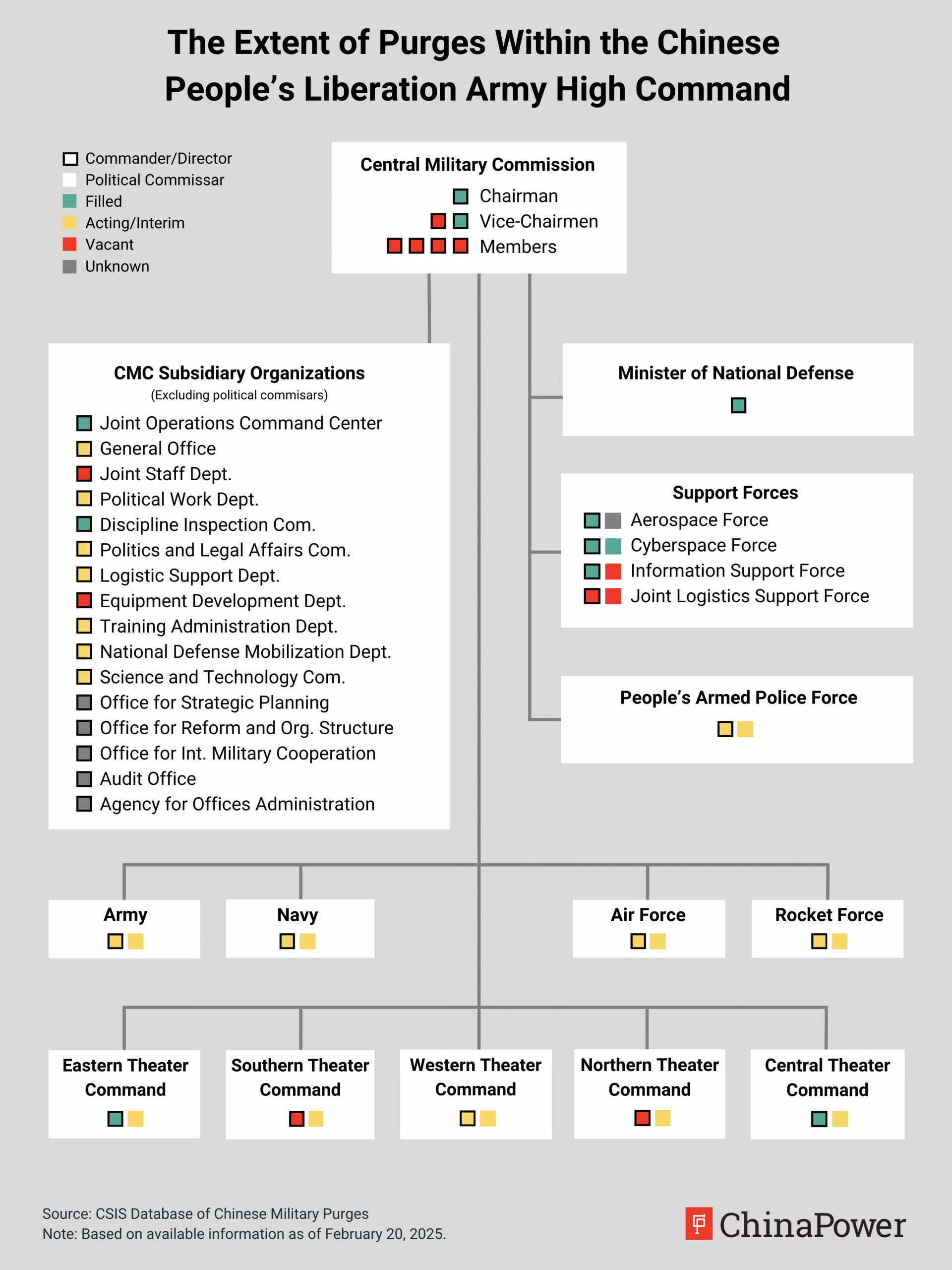
The PLA’s ability to backfill many positions may explain the lack of significant, notable disruptions in China’s military operations in 2025 compared to prior years. Some experts argue that there may be incentives for the PLA to compensate by engaging in more aggressive military activity as it is undergoing massive internal changes to demonstrate that capabilities have not been eroded and that the PLA can still readily defend Chinese interests.
Last year, according to analysis by the CSIS China Power Project, the overall annual count of Chinese military activities increased in the Taiwan Strait, South China Sea, near Japan, and beyond the First Island Chain. There was, however, an observed minor year-over-year decrease in PLA activities against Taiwan in the latter portions of 2025 compared to 2024. Similarly, although the number of PLA naval vessels operating in the waters around Japan increased in 2025, the average duration of each PLA Navy vessel’s trip was shorter in 2025 than the prior year.
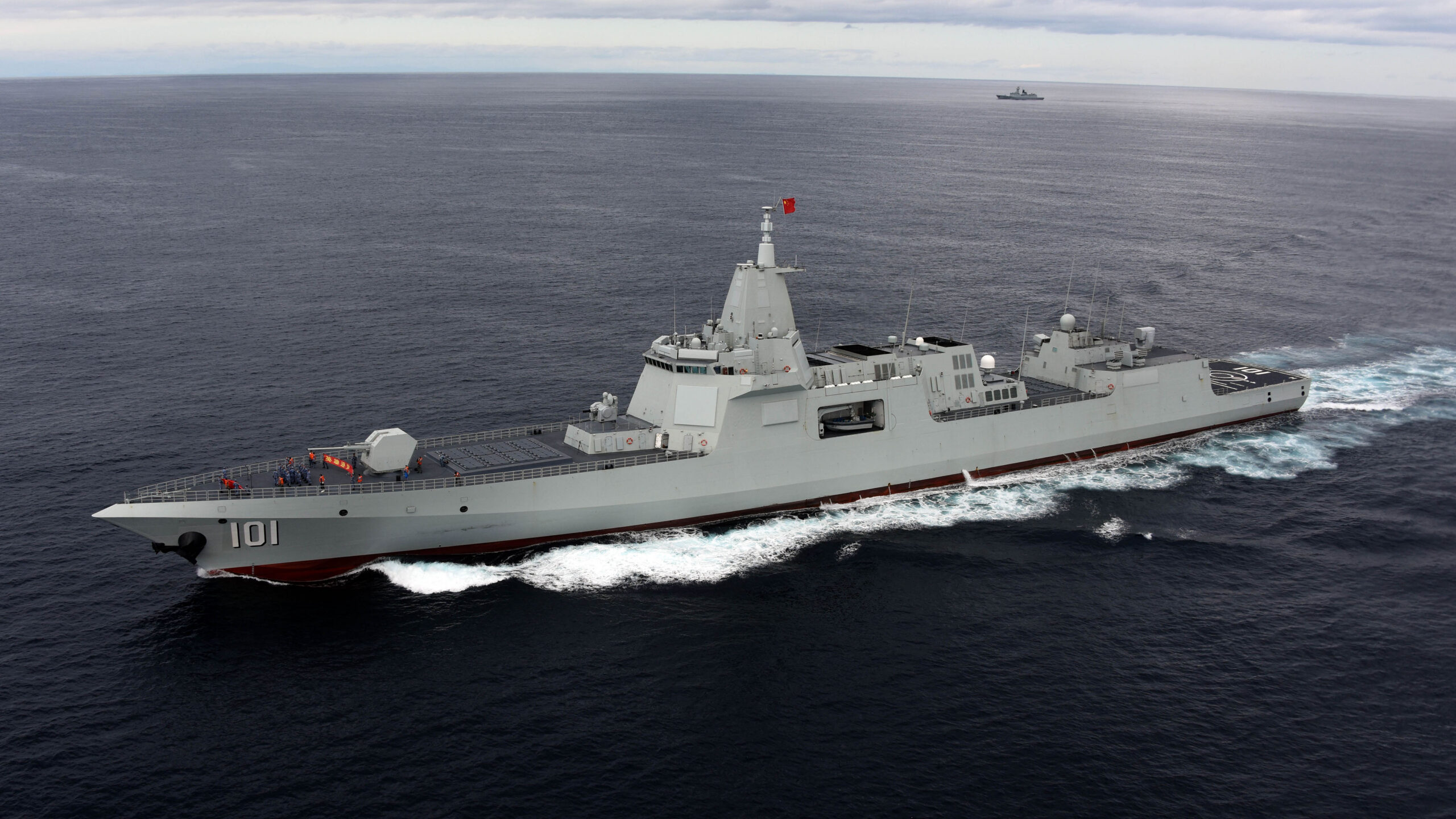
Analysis of open-source data shows that the Chinese military increased its activities in the Indo-Pacific across multiple vectors in 2025. Explore data and analysis of PLA activities in this ChinaPower feature report.
Yet a closer examination reveals examples where leadership gaps could have negatively impacted the PLA’s ability to conduct larger, more complex military exercises. Two different examples suggest this.
First, the purge of the leadership within the ETC—including Commander Lin Xiangyang (林向阳), Deputy Commander of the ETC and Commander of the ETC Navy Wang Zhongcai (王仲才), and ETC Army Commander Kong Jun (孔军)—as well as CMC vice chairman He Weidong (何卫东) by March 2025 likely impacted China’s military exercises later that year vis-à-vis Taiwan.
Likely as a result of these purges, China’s two large military exercises around Taiwan in 2025 were delayed. In 2024, China reacted within three to four days to what it viewed as “problematic” behavior from Taiwan to launch two Joint Sword exercises in May and October. In contrast, it took the PLA 19 days to launch a large-scale exercise in April 2025 (after Taiwan’s president William Lai gave a speech) and 12 days in December 2025 (in response to a record-setting U.S. arms sale to Taiwan).
Not only were the two large-scale exercises delayed in 2025, but they were also different in size and nature, and they followed different naming conventions. The April 2025 Strait Thunder-2025A exercise was impacted the most and was designated a military drill (演练), not a typical larger military exercise (演习). It was hastily organized and was not as well planned as the larger 2024 exercises despite taking almost two additional weeks to put together. For example, the ETC did not announce the name of the exercise until the second day. In contrast, after a new ETC commander was appointed in mid-December 2025, Justice Mission 2025 was conducted more in line with the 2024 Joint Sword exercises.
A second curious and noticeable change in PLA military exercises in 2025 was the decrease in Chinese military exercises with Russia. In 2025, China engaged in only six exercises with Russia—less than half of the 14 exercises China undertook with its neighbor in 2024. Missing from the 2025 slate were the more complex, multi-domain exercises that involve more than just one service. In 2024, China and Russia held four multi-domain exercises, and the two countries have had at least one such exercise annually since 2018.
Although there are natural fluctuations in annual exercise counts, this significant drop in count and the absence of more complex operations suggest more factors at play. It is possible that the PLA purges of the CMC Joint Staff Department undercut China’s ability to plan and execute such complex exercises that not only involve coordination between PLA service branches, but also significant pre-planning with Russia. Three Joint Staff Department Deputy Chiefs Xu Qiling (徐起零), Cao Qingfeng (曹青锋), and Jing Jianfeng (景建峰) were likely purged in 2025. This was followed by the purge of department chief Liu Zhenli in early 2026.
The Joint Staff Department has long played a key role in China’s military diplomacy and has directed and planned complex exercises with Russia. In 2021, for example, then head Li Zuocheng (李作成) served as the exercise director of the multi-domain Zapad/Interaction-2021 exercise between the two countries. Similarly, in 2023, Li’s successor and then Chief of the Joint Staff Department Liu Zhenli met with his Russian counterpart to deepen military cooperation and to confirm Russian participation in the multi-domain Northern/Interaction-2023 exercise organized by China.
Overall, it appears so far that acting lieutenant generals are sufficient to largely maintain or continue smaller scale daily operations, but there is some evidence that the purges are negatively impacting larger and more complex exercises. Beyond exercises, it is unclear if these interim leaders have the authority or experience needed to implement larger changes in PLA direction or activities and if these interim leaders can handle an unexpected accident or crisis.
What the Purges Mean for the PLA’s Future
Having gutted the PLA’s leadership, Xi Jinping will have to turn to reconstituting the military high command in the coming years. Xi has significant choices to make, including whether he wants to keep the existing leadership structure or implement more changes to the size, composition, and configuration of the Central Military Commission as well as subordinate organizations. Depending on what Xi intends to do, this could take years or even longer to see the full transformation. This recent massive leadership purge as well as Xi’s major reorganization of the PLA in late 2015 and 2016 showcase that Xi is not shy about making bold changes to his military.
However Xi chooses to move forward, he will have to consider two key factors: political loyalty and competence. Political factors will be paramount for Xi. Unlike most militaries, the PLA is not loyal to the state but to the Communist Party. Xi and the CCP leadership view the military first and foremost through the lens of regime security. While corruption is often cited as a reason for removing senior leaders, charges of corruption do not explain the full extent of the purges and political dynamics played a key role.
The purges of Zhang Youxia and Liu Zhenli are instructive. The PLA Daily stated that Zhang and Liu were removed for fueling “political and corruption problems that threaten the party’s absolute leadership over the armed forces and undermine the party’s governance foundation,” and it said they had “seriously trampled on and undermined” Xi’s authority as CMC chairman. Some have speculated that this indicates Xi felt Zhang in particular had amassed too much influence within the PLA or that factionalism threatened CCP rule over the military. Whatever way Xi seeks to refill or restructure the CMC, he will likely seek candidates that are not only loyal to him but have demonstrated little evidence of amassing their own followers within the military.

To learn more about the implications of PLA purges, read this CSIS report, which brings together insights from leading experts on the Chinese military.
The political loyalty of the PLA is poised to become more important as Xi gets closer to tapping a successor and to ensure that his successor continues in the direction he desires. Previous Chinese leaders have added their potential civilian successors to the CMC as vice-chairmen. When former leader Jiang Zemin stepped down from his role as leader of the CCP, he retained his position as chairman of the CMC for two additional years. That hamstrung his successor Hu Jintao and allowed Jiang to continue influencing politics beyond his tenure as party leader. As he remakes the PLA, Xi could want to ensure that he retains lasting influence over the military.
Beyond political factors, Xi will be looking to appoint competent new senior leaders who can achieve his ambitious military modernization agenda and make the PLA more lethal. This could involve refilling the CMC, but Xi could also keep the CMC small and empower CMC subordinate organizations. Xi could also take more drastic measures and scrap the CMC as a whole—which would not be difficult to do now since there is only one other member left—and adopt a military high command that resembles that of the United States. Regardless of what structure emerges, Xi will need more senior operational leaders.
In the wake of Xi’s purges, the usual crop of candidates has been heavily winnowed, and it could take years to equip a new crop of leaders with similar experience. Besides Zhang Shengmin, who is the only uniformed officer remaining on the CMC but has little operational experience, there are only 3 three-star generals from which Xi could immediately choose:
- Admiral Dong Jun (董军) is currently the Minister of National Defense. Notably, Dong appears to have gone under investigation previously, but he has not yet been purged. If he indeed emerges from these purges, that could signal Xi has a level of trust in Dong that would make him a fit for the CMC. Prior to becoming defense minister, Dong was commander of the PLA Navy, and he previously also had experience as deputy commander of the Southern Theater Command, which has responsibility for the South China Sea, as well as positions in the ETC (responsible for Taiwan).
- General Yang Zhibin (杨志斌) is the commander of the ETC and one of only two generals to have been promoted to a three-star general in 2025. A former air force pilot, Yang previously served as a deputy commander in the Southern and Western Theater Commands. His promotion suggests he has so far survived the ongoing wave of purges and is therefore a contender for future promotions.
- General Han Shengyan (韩胜延) is now commander of the Central Theater Command and was promoted to a three-star general alongside Yang Zhibin in 2025. Like Yang, he is from the PLA Air Force, and his promotion suggests he is a future candidate for the CMC. Notably, he was bestowed the honor of serving as the commander-in-chief of China’s September 2025 military parade commemorating the 80th anniversary of the end of World War II.
Beyond these three, a natural pool of people from which to draw would be the current members and alternates of the CCP Central Committee who have not already been purged or placed under investigation. Comparing the Central Committee roster to the CSIS database of purged individuals, only 17 members and alternates remain unblemished (out of the 67 members and alternates originally on the committee).
Still, it is not even clear Xi will pull from this group. Precedent suggests he could look farther afield. At the 20th Party Congress in 2022, Xi tapped He Weidong to become vice chairman of the CMC, which meant he skipped a PLA grade (jumping from the theater command leader level to the CMC vice chairman level). He was also not a member or alternate member of the CCP Central Committee. Xi could take similar moves with whomever he taps to promote. 
The authors would like to thank Jonathan A. Czin, Taylor Fravel, Allie Matthias, Phillip Saunders, and Joel Wuthnow for providing feedback on data and analysis.