
By: Suyash Desai
November 24, 2025
The Chinese People’s Liberation Army (PLA) is edging toward a new “cold start-style” military operational posture, with the goal of being able to conduct rapid, high-intensity offensive operations before an adversary can mobilize or intervene. This pivot is part of the PLA’s larger mobilization reforms, which China initiated in 2017-18. However, it was not until 2022, spurred by the visit to Taiwan by former Speaker of the U.S. House of Representatives Nancy Pelosi, that the PLA began implementing these reforms in real-time military exercises and drills. Since then, the PLA has begun conducting advanced exercises around Taiwan, focusing on a cold start military operational posture and capabilities, and it is replicating these on a relatively limited scale within the Tibet and Xinjiang Military Districts. Unlike other experiments, which are generally first implemented in the Eastern Theater Command (ETC)—a laboratory of implementation of the Chinese military reforms, the PLA has better managed to achieve its cold start posture in Tibet, Xinjiang, and possibly the entire Western Theater Command (WTC), which is responsible for an India contingency.
Through careful reading of PLA military textbooks, tracing evidence in Chinese and PLA leadership speeches, mapping institutional changes, and examining recent major PLA military exercises and drills, this article shows how China’s armed forces are steadily moving towards a long-sought cold start-style operational posture.
Conceptual Understanding of the PLA’s Cold Start Posture
The cold start concept in PLA operational discourse refers to the capability to shift rapidly from peacetime routines to combat readiness without obvious prior indications. The most important outcome in such an operation is preserving the element of surprise. Historically, this has been a limitation due to the PLA’s former division-regiment structure, as the bulky force took time to mobilize. However, since the turn of the century, and especially after Xi Jinping’s ascent to power, the PLA has managed to move away from its division-regiment structure to a battalion-brigade formation. This new force structure, which is mainly dependent on combined armed brigades, enables greater mobility and speed—also the dominant themes of all recent major Chinese military exercises in the past few years.
In Chinese military literature, the ability for units to “hear the order and immediately mobilize” (闻令即动) is given top-most importance. This concept has also featured in the PLA’s important reference books like Science of Military Strategy (战略学). It demands institutional mechanisms to support and issue orders quickly down the chain of command. Furthermore, almost all editions of Science of Military Strategy emphasize the need to reduce lengthy administrative approvals during a crisis. It also highlights that potential operational readiness, equipment, personnel, and supplies are to be kept at readiness levels at all times to minimize the time for deployment once a decision is made at the top-most Central Military Command (CMC) level. More specifically, the latest 2020 edition highlights the 24-48 hour “golden window” (金色窗口), in which the warzone headquarters must complete force generation and seize the initiative.
Other operational-level textbooks of the PLA have tightened the clock even further. The 2012 Lectures on the Science of Joint Campaigns (联合战役学教程) and the 2018 revision of the Science of Campaigns (战役学) discuss a “joint rapid-reaction campaign” that must be assembled under a single theater network. Likewise, the 2023 Army Logistics Quarterly identifies speed and efficiency as problems that could occur during mobilization for an invasion of Taiwan. Equally importantly, the 2015 handbook Informatized Army Operations (信息化陆军作战) highlights that victory depends on “firing the first shot within minutes” (分分钟打敌). All these military texts emphasize speed as a key factor in compressing the timeline, launching quickly, conducting rapid action, and striking a decisive blow.
Tracing Evidence in Leadership Speeches
Since 2015, China’s top civilian and military leaders have repeatedly emphasized the idea “start fast, end fast” (迅即开战,速决制胜). This idea stresses permanent readiness, quick integrated joint operations, and most importantly, finishing the task before the intervention of outside forces. The recent indicators can be traced directly from the Chinese Communist Party (CCP) General Secretary Xi Jinping’s classified speech to the officers of the Southern Theater Navy at Zhanjiang on April 11, 2023. He told the PLA to rapidly deploy newer units and capabilities, demanding a response time that leaves no opportunity for adversaries to mobilize. This also fits the signature messaging that he has maintained since 2012 to “always be ready for war” (随时准备). Similarly, he has regularly used the phrasing “be ready to fight and win wars” (能打仗,打胜仗), and he has said to “focus minds and energy on preparing for war and maintaining a high state of alert” (把全部心思和精力放在备战上,保持高度警戒状态). He has also demanded that “troops must keep training and be ready to fight at any moment” (部队还是要练,要随时准备打仗) and warned against “sleeping on one’s sword” (枕戈待旦).
“Troops must keep training and be ready to fight at any moment.”
Xi Jinping, 2018
Xi is not the only one speaking on these issues—other Chinese military leaders have as well. For instance, on March 14, 2025, during a symposium held in Beijing to commemorate the 20th anniversary of the Anti-Secession Law, the former Eastern Theater Commander General Lin Xiangyang, who was sacked in the October 2025 purges, claimed that the PLA will stay on 24-hour alert, is ready to fight at any moment, and will fully prepare for combat. This is not a one-off incident. Earlier, on January 2, 2023, PLA Army Commander General Li Qiaoming ordered forces to be ready with elite formations that can be called, fight, and win on the spot. Similarly, Zhang Youxia, the first-ranked CMC Vice Chairman, while visiting Beijing’s garrison unit on February 8, 2024, commanded the troops to “prepare for real-case preparation with rapid fielding of new and advanced forces” (为实战做好准备,加快新型先进力量的快速列装). However, the most interesting evidence comes from one of the PLA Rocket Force (PLARF) battalion commanders from Tibet on August 6, 2024, who claimed, “If I am used in the first battle, I must defeat the enemy in one blow and seize control at once” (首战用我,必须一招制敌、一举夺控). The phrase makes clear that the first 72-hour shock ethos of the PLA’s cold start approach has reached down to the company commander’s level.
Notably, these speeches reveal a typical typology of China’s political-military system: Once the General Secretary issues a directive—whether in a public address or in talks with a foreign leader—it is swiftly echoed at every echelon, from the vice-chairmen down to the most remote battalion commander.
Evidence of Implementing a Cold Start Posture
Although military texts supporting the cold start approach have long been present for the PLA, the institutions enabling this posture were not ready until recently. In the recent round of PLA reforms, more specifically since the second half of 2022, mobilization has been an important focus of the Chinese military leadership. The CMC has taken a three-pronged approach focusing on building and reforming institutions, increasing and revising education programs, and practicing implementation in training drills and limited real-time scenarios.
First, the Chinese leadership has focused on institutional reforms, such as building National Defense Mobilization Offices (NDMOs) across China, including in the remotest regions of Tibet and Xinjiang. This has freed the PLA from administrative duties, as these civilian mobilization offices have taken up major administrative responsibilities. It has occurred alongside ongoing larger force structure reforms that were initiated in the previous decade and include the PLA’s move towards the brigade-battalion structure from the division-regiment structure, theater command formation, and service level changes.
The PLA has also worked on streamlining command structures that have aimed at shortening decision-to-action timelines. At the operational apex, integrated joint operations command centers depend on a unified Command, Control, Communications, Computers, Intelligence, Surveillance, and Reconnaissance (C4ISR), which combines data from satellites, autonomous vehicles, electromagnetic and signals assets, and civilian streams in near-real time. This allows regional commanders to shorten the traditional loop from hours to minutes, thus enabling faster decision-making and implementation. Improvements in digital command-and-control systems, pre-positioned logistics under military-civilian fusion policies, and dedicated rapid-reaction brigades that train for immediate deployment have improved turnaround time from decision making to implementation. Although deeper tactical details are often confined to internal publications, recent events indicate that the PLA is leveraging these changes to reduce the lag between order issuance and force deployment, rendering the PLA faster and more agile at every level.
“Recent events indicate that the PLA is leveraging these changes to reduce the lag between order issuance and force deployment, rendering the PLA faster and more agile at every level.”
Second, at the implementation level, once the institutions are ready, it comes down to the man behind the machine. Therefore, the second stage of Xi’s military reforms repeatedly focused on personnel training and education. Issues like corruption, inefficiency, talent-technology mismatch, and the lack of institutional support have been historical limitations for the PLA, with negative impacts on rapid mobilization. However, after mid-2022, Beijing started training the PLA personnel with mobilization-specific thinking. The 2023-24 force-wide education drive on “Xi Jinping Thought” demanded that battalion commanders pair ideology classroom lessons with mobilization tabletop drills. Furthermore, the professional military education system has been rewired by making unit-level and brigade-level surprise combat-readiness tests a new normal in all five theater commands before they can join large-scale periodic drills. These renewed personnel policies have been given legal and institutional support through an overhaul of national defense mobilization structures and implementation of the revised National Defense Law (2020) and the New Reservists Law (2022), embedding mobilization education as a national obligation. Together, these political signals, unit-level education, militia upgrades, and legal provisions are attempting to convert quicker mobilization from a posture-level requirement into the PLA’s everyday professional reality.
Finally, at the ground level, since 2022, the PLA has managed to conduct major military exercises and drills around Taiwan and in Tibet and Xinjiang with minimal prior notice, illustrating the slow but steady implementation of its cold start features.
The Taiwan Strait was the locale for multiple unannounced and fast military drills in the last few years. These drills featured a large number of ships, aircraft sorties, ballistic missiles, and multiple Chinese paramilitary forces operating in tightly contested spaces. In August 2022, after Speaker Pelosi’s visit, the PLA ringed Taiwan with seven live-fire exclusion zones, ballistic-missile firings, and deployments of nuclear submarines, aircraft carriers, and other surface vessels. This was the first complete encirclement since the 1995-96 crisis and started a series of new, fast-moving military exercises, eventually bringing about significant progress toward a cold start posture.
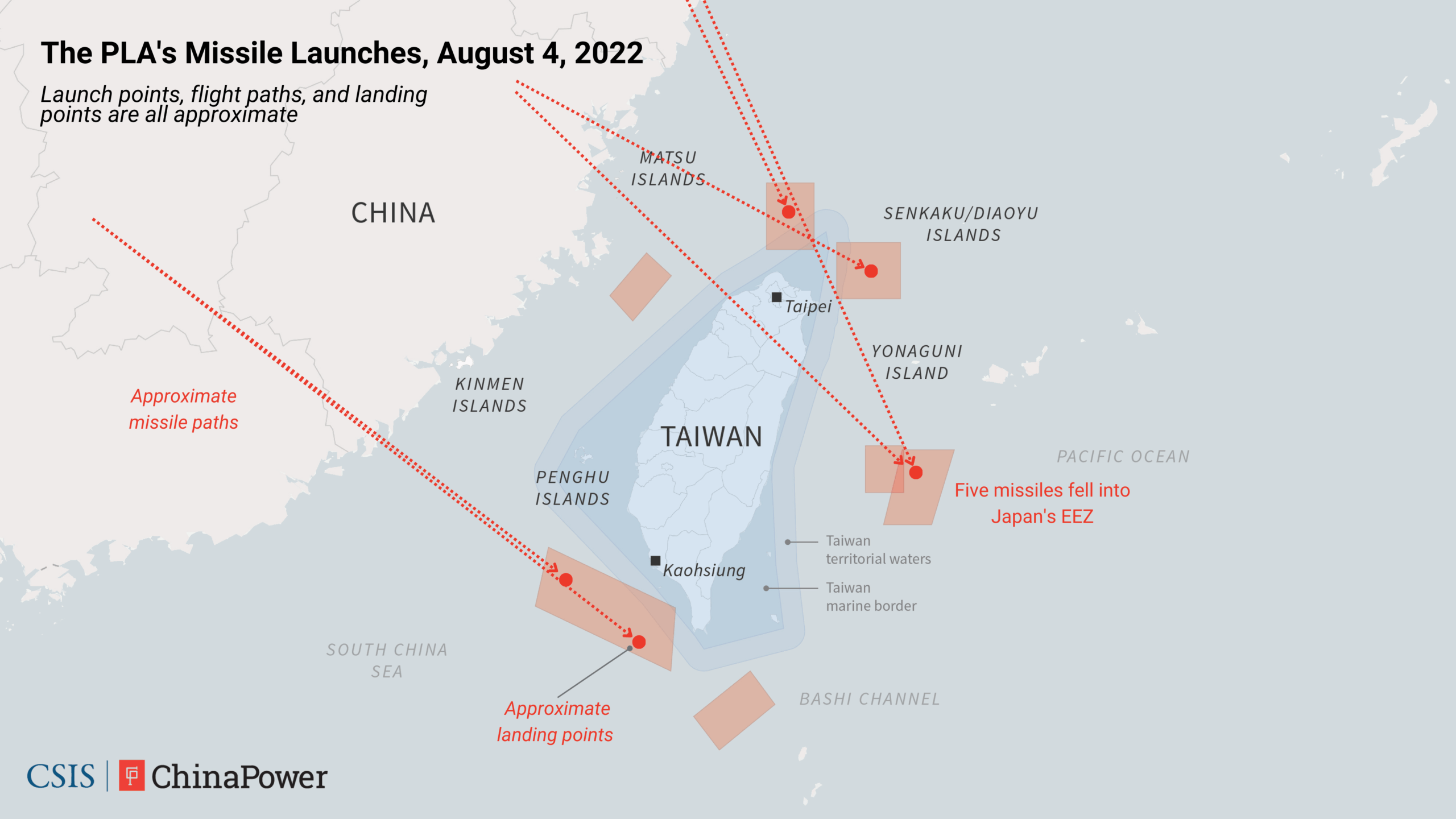
Later, in April 2023, during the Joint Sword military exercises around Taiwan, the PLA announced and activated the drills the same morning, with the PLA Rocket Force, Navy, and Air Force participating in these drills. Similarly, the Joint Sword-2024A drills of May 2024 broadened the PLA’s playbook with the inclusion of J-20 and J-16 fighters, Type 071 amphibious ships, and Rocket-Force fire-support in multiple sectors . Notably, these drills displayed the PLA’s ability to conduct integrated, multi-domain operations from stand-by to full blockade rehearsal on political cue.
The Joint Sword 2024B drills in October 2024 compressed the timeline even further as Beijing’s first communiqué went out at 05:01, and within hours the Liaoning carrier group was operating east of Taiwan while the ETC executed sea-air readiness patrols, port-quarantine and missile-strike drills, and a record 153 PLAAF sorties. Activities concluded by the same evening at 18:06, signaling China managed the mobilization and integration of four services, plus the Coast Guard, in a short duration. More recently, the April 2025 Strait Thunder-2025A drills also displayed the speed of mobilizing the armed forces for multi-axis blockade and precision-strike drills within 48 hours.
It is worth noting that the PLA was able to prepare in advance for some of these activities. For instance, the PLA anticipated President Lai Ching-te’s National Day speech, which occurs annually, and had time to plan accordingly. Nevertheless, the PLA clearly sought to emphasize rapid action and forego prior warnings of their activities to highlight progress toward rapid mobilization.
Taken together, these exercises demonstrate a new arc that mirrors the cold start concept along with multi-domain integrated joint operations, both of which are among Xi’s stated objectives for the PLA to achieve the status of a “world-class force.” Put simply, through these changes, the Chinese armed forces are attempting to mobilize quickly and complete the mission before the intervention of an outside force.
The Classic Chinese Cliché of East Versus West
Generally, the ETC is known to be the PLA’s testing lab. It is first among equals as it is responsible for the Taiwan contingency, the PLA’s primary strategic direction since 1993. This theater command is the prime beneficiary of military modernization, as many major policy changes and reforms are first tested and implemented there. In contrast, Xinjiang and Tibet are referred to as “two ugly ducklings” (两丑鸭) because they were historically the last two regions to benefit from any modernization, upgrades, or reforms. However, and very surprisingly, these two India-facing military districts (MDs), along with the Western Theater Command (WTC) as a whole, are the biggest beneficiaries of this change.
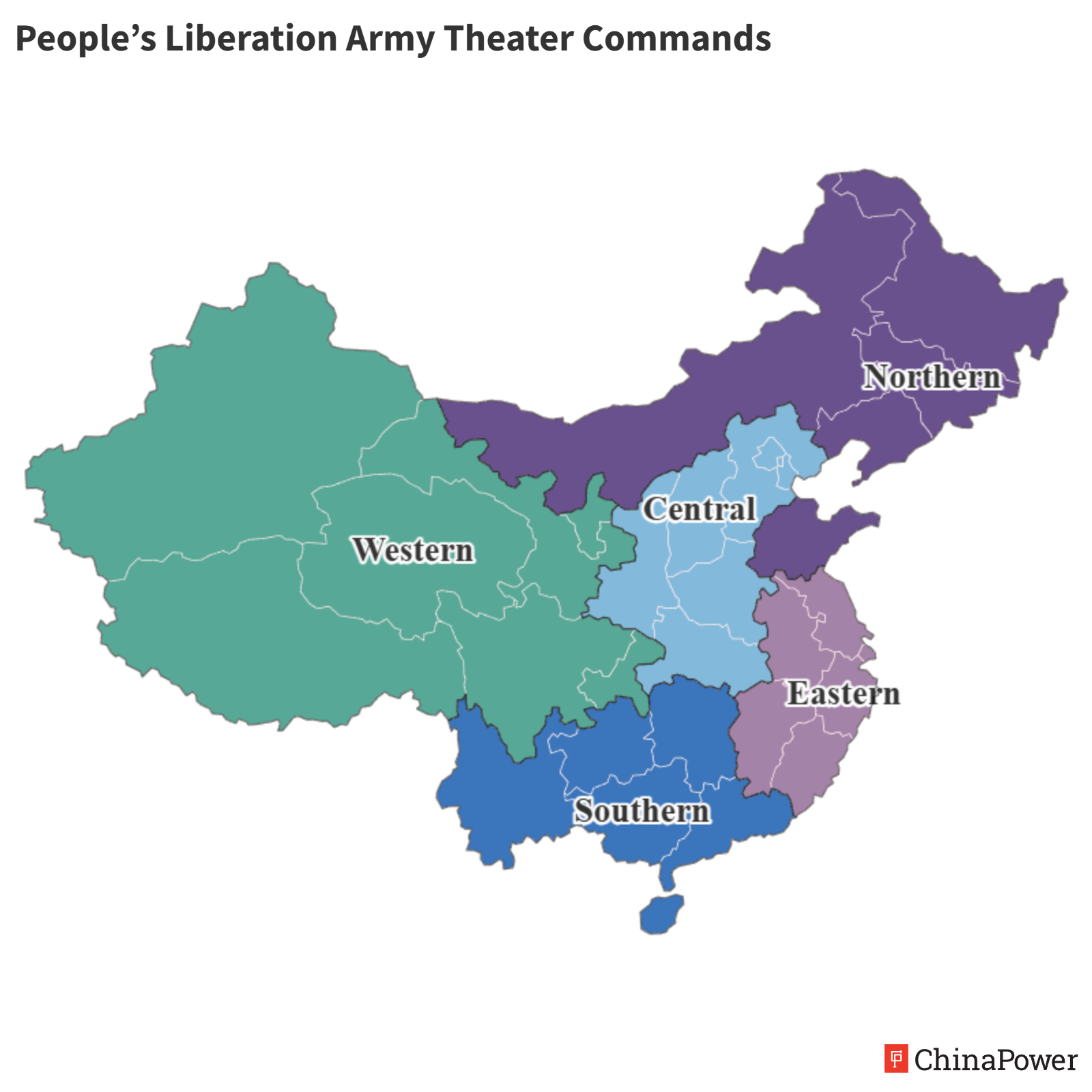
Since the June 2020 Galwan clash between Chinese and Indian forces, these three regions have steadily moved toward a cold start posture by compressing mobilization timelines. This is partly due to forward-basing combined-arms brigades, which were tasked with managing the threat emerging from the close proximity of engagement with the Indian forces across the Line of Actual Control. But more specifically, these conclusions could be drawn from continuous military drills and rehearsals on the Tibetan plateau, especially after the Galwan clash.
For instance, since late 2021, the WTC has organized its training calendar with drills whose defining metric is speed. In August 2021, during its periodic Snowfield Mission exercise, the TMD rushed more than ten brigade-sized structures—nearly 10,000 troops—and hundreds of armored vehicles on the plateau under cover of darkness in less than a day. In January 2023, a Xinjiang-based border company was jolted awake by a pre-dawn alarm, and within minutes, was made to charge through the snow-covered valleys to intercept “intruder drones” as an emergency practice drill. Similarly, in March and April 2024, the 76th Group Army’s helicopter brigade and air defense brigades were tested for immediate deployment in less than a 24-hour window. Additionally, the 76th Group Army’s chemical defense detachment was also sent into a high-altitude valley scenario in July 2024 after a pre-dawn alarm, thus testing their readiness.
These are just select episodes of consistent and ongoing events in these regions over the past few years. Viewed together, they highlight a clear trajectory of successive years of trimming hours off alert, transport, and setup timelines, signaling a capacity to launch hard-hitting thrusts along the Himalayan frontier on shorter notice rather than weeks of build-up. Heavy investments in dual-use transport and supporting infrastructure, expanded airfields across these regions, along with the above-mentioned changes, have helped streamline CS4ISR and compressed mobilization timelines.
Notably, documents published since 2020 show four major instances in which PLA mouthpieces have praised these regions and associated WTC-related Group Armies for moving troops faster than other theaters—including the ETC—thereby elevating the WTC as a model for other regions. The first instance was in September 2021, when a transport and delivery dispatch center inaugurated 23 military-civilian air corridors for a thousand-kilometer frontier delivery of essential equipment and services in less than a single day in the west. Then, in March 2022, a 77th Group Army unit traveled from Chengdu to Shigatze in record time. Finally, in 2025, two instances stood out: real emphasis on faster deployment during the PLA’s annual training program near the Indian border in South Xinjiang in January, and later emphasis on and implementation of rapid deployment during live-fire drills at a regiment-level under the Xinjiang Military District in July 2025.
The first two instances could probably also be attempts by the military leadership to motivate the forces in these regions, which were then engaged in a cross-border stand-off with India. But the 2025 instances, which took place after China and India disengaged, indicate an institutionalization of rapid deployment in the PLA’s annual training of moving toward a cold start-style operational military posture, and suggest the WTC has taken the lead over ETC and other theater commands in implementing it.
Significance and Limitations
The PLA’s capability to launch an assault within 24-48 hours of a political cue will drastically erode the existing Indo-Pacific deterrence threshold. It increases the responsibilities and burden on the defenders, such as India, the United States, Taiwan, Japan, and probably Australia and others, to prepare and respond quickly, deploy earlier, identify patterns, and fight from the outset in a high-tempo environment. It also shortens the crisis-to-decision window for these countries, thus compelling them to invest in advanced forward-based ISR capabilities.
A cold start capability does not guarantee Beijing a victory in a stand-off or conflict; however, it does significantly increase the likelihood that China can achieve a first and major blow against other forces if they do not improve their deterrence posture. Below a major standoff or conflict, it also increases the probability that Beijing can succeed in achieving its limited territorial goals with India, in the South China Sea, or elsewhere, through coercive and gray zone activities.
Despite improvements, Chinese military texts are upfront in acknowledging that some PLA campaigns, such as amphibious operations or a large-scale military blockade campaign against Taiwan, cannot be conducted with an absolute element of surprise. These operations need major build-ups, which are observable by China’s adversaries through space-based ISR and other capabilities. Nevertheless, achieving a complete cold start-style mobilization posture will certainly have serious implications for the deterrence framework that maintains the Indo-Pacific’s uneasy peace. 
Suyash Desai is a political scientist specializing in Chinese military affairs, security and foreign policy issues, nuclear strategy, India-China relations, and strategic and security developments in East Asia and the Indo-Pacific region. Currently, he is a Non-Resident Fellow at the Foreign Policy Research Institute, Philadelphia. More on www.suyashdesai.com. He can be reached at @suyash_desai.
The author sincerely thanks Carnegie India and Dr. Rudra Chaudhuri for providing a platform to present this argument for discussion and feedback before publication. The author also thanks Mr. Saheb Singh Chadha for his inputs.